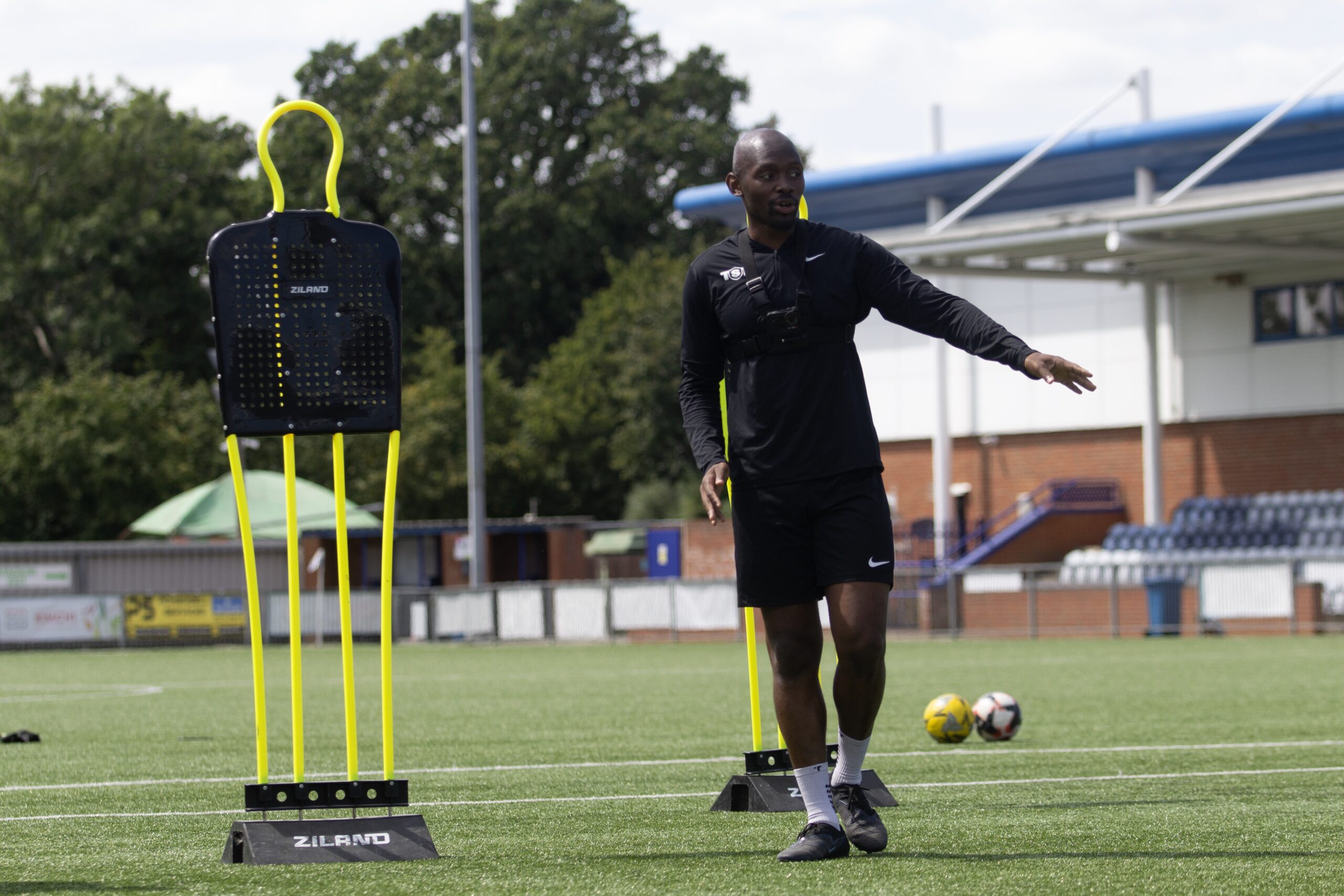
When people hear “striker coaching”, they often picture a player taking shot after shot at goal.
Finishing matters, but scoring consistently requires much more than striking the ball well. A striker must recognise space, lose defenders, connect with teammates and make fast decisions under pressure. The final shot is only the last action in a longer sequence.
That is why specialist striker coaching should develop the complete player rather than isolate one technique. The aim is to help a forward understand how chances are created, how to become useful in different phases of an attack and how to execute when the opportunity finally arrives.
At Half a Yard, those details are informed by Jordan Antonio Brown’s experience as a striker in academy and senior football across England, Germany and Canada. Different teams, countries and styles of play create different demands, but the fundamental responsibilities of the position remain recognisable.
Striker development begins before the ball arrives
The most visible part of a striker’s performance is what happens when they receive the ball. Coaches and spectators see the first touch, pass, dribble or shot.
The decisive work often begins earlier.
A forward must scan the pitch, recognise where pressure will come from and decide whether to move towards the ball or threaten the space behind the defence. Their starting position can open a passing lane, isolate a defender or create room for a teammate—even when they never receive the pass.
Specialist coaching helps a player understand those moments. Instead of learning one movement by memory, the striker learns to read clues such as:
- The body shape of the player in possession.
- The position and balance of the nearest defender.
- The available space between and behind defenders.
- The position of supporting teammates.
- Whether the attack needs depth, width or a player to connect the play.
This turns movement from constant running into purposeful action.
Intelligent movement
A striker should be difficult for defenders to see and predict.
Standing directly in front of a centre-back makes the forward easy to monitor. Small changes in position can create a much harder problem. A striker might drift onto a defender’s blind side, move towards the ball before spinning behind, or hold their run until the defender looks away.
The correct movement depends on the situation. Sometimes the forward should run beyond the defensive line. At other times, dropping short creates space for another attacker. Inside the penalty area, a delayed movement towards the near post, far post or cut-back zone may create the clearest chance.
Specialist sessions should teach the player how to choose between these movements, not simply demand more running.
Protecting the ball and linking play
Strikers do not always receive facing the goal. They may need to control the ball with a defender applying pressure from behind.
Effective link play allows the team to move up the pitch and brings midfielders and wide players into the attack. It requires more than physical strength. The striker needs an appropriate starting position, awareness before receiving and a first touch that protects the ball.
Key details include:
- Using the body to place the defender on the safe side of the ball.
- Receiving on the foot furthest from pressure when possible.
- Setting the ball with the correct weight and angle.
- Knowing when to play one touch and when to secure possession.
- Moving again after the lay-off instead of admiring the pass.
A forward who can link play becomes useful even during periods when scoring opportunities are limited.
Creating separation from defenders
Strikers rarely receive unlimited time and space. They must learn to create a small advantage.
Separation can come from a sharp change of direction, a change of speed, clever body contact or a disguised first movement. The striker may step towards the defender before pulling away, move across the defender’s path or wait outside their eyeline before accelerating.
The objective is not always to create several metres of space. At higher levels, half a yard can be enough to receive, turn or shoot.
Training should place the striker against realistic pressure. Unopposed repetition can refine technique, but a live defender forces the player to judge timing, distance and contact. These are the details that transfer into matches.
Better decisions under pressure
A striker may have only a moment to choose an action.
Should they shoot first time, take a controlling touch or set a teammate? Should they attack the near post or delay for a cut-back? Should they spin away from pressure or protect the ball and wait for support?
There is no single answer that works in every situation. Good decision-making develops when training contains relevant pictures and meaningful choices.
A useful practice should vary the delivery, defensive pressure and available space. The player must gather information and solve the problem rather than repeat the same predetermined finish.
The coach can then help the striker review three things:
- What information did the player notice?
- Why did they choose that action?
- Could a different choice have created a better outcome?
This approach develops understanding as well as technique.
Finishing with confidence and purpose
Finishing is still a central part of striker development, but it should be connected to realistic movement and decisions.
A striker needs a range of finishes: one-touch contacts, shots across goal, near-post finishes, rebounds, headers and attempts under pressure. They also need to understand when accuracy, speed or disguise matters most.
Confidence grows from preparation. Repeating realistic actions gives the player evidence that they can handle similar moments in matches. The objective is not to remove every miss—no striker scores every chance—but to create a repeatable process.
That process might include scanning the goalkeeper, preparing the body early, choosing a target and committing to the finish. When a chance is missed, the player can return to those controllable details instead of allowing frustration to shape the next attempt.
Why playing experience can help a striker coach
Experience alone does not automatically make someone an effective coach. A coach must still observe carefully, communicate clearly and adapt ideas to the age and level of the player.
Playing the position can nevertheless provide valuable context. A former striker understands how quickly spaces disappear, how defenders use contact, how confidence can change after a missed chance and how tactical demands vary between teams.
Jordan’s journey included West Ham United’s academy, a first-team Europa League appearance and senior football in Germany and Canada. Those environments offered different versions of the game and different expectations of a striker.
Half a Yard turns that experience into practical details that players can apply. The goal is not to ask every forward to play in exactly the same way. It is to give each player a stronger understanding of the position and help them develop tools suited to their own game.
Who is specialist striker training for?
Specialist coaching can support players at different stages, from ambitious developing forwards to semi-professional and professional players.
The content and level of difficulty should change with the player. A developing striker may need more time on movement patterns and basic finishing mechanics. An experienced player may need smaller tactical details, position-specific problem solving and feedback tied closely to match situations.
The common requirement is a willingness to learn. Specialist work is most valuable when the player wants to understand why an action succeeds, not simply complete another set of shooting drills.
Frequently asked questions
Is striker coaching only about shooting?
No. Effective striker coaching also develops movement, scanning, link play, separation, decision-making and the ability to operate under pressure. These skills help create the chance before the shot happens.
What is the difference between team training and specialist striker coaching?
Team training must serve the needs of the whole group. Specialist coaching can spend more time on the specific situations, movements and technical details a striker repeatedly faces.
Can striker coaching improve off-the-ball movement?
Yes. Sessions can help players recognise when to drop short, run behind, move onto a defender’s blind side or attack different spaces inside the penalty area.
Does a striker need to be physically strong to hold up the ball?
Strength can help, but positioning, balance, awareness and the direction of the first touch are equally important. Good technique allows a forward to protect the ball more effectively.
Who coaches at Half a Yard?
Half a Yard is led by Jordan Antonio Brown, a striker whose development and senior career included football in England, Germany and Canada. His playing experience informs the position-specific details used in the sessions.
Develop your game with Half a Yard
Half a Yard provides specialist striker and finishing development for ambitious players aged 14 and above, from developing forwards to semi-professional and professional players.
Explore specialist striker coaching or book a session.
Developed from a Half a Yard coaching carousel. View the original Instagram post.