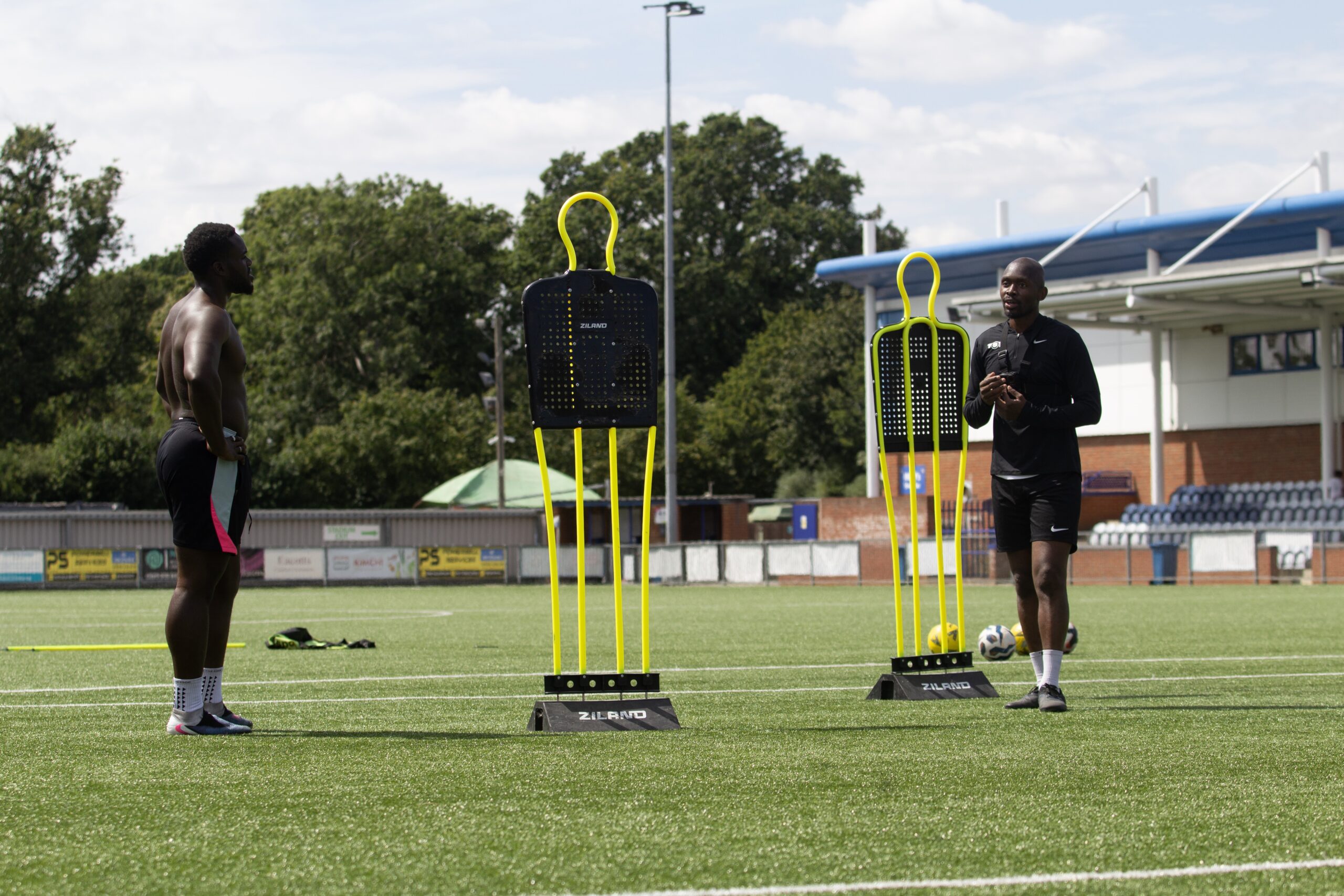
The goal is the moment everyone remembers.
The striker makes the run, receives the ball and finishes. To a spectator, the action may last only a few seconds. The work that makes it possible has been built over hundreds of earlier repetitions.
Effective striker training must develop more than the final strike. It should prepare the player to recognise the situation, create an advantage and execute the correct action under pressure.
That means every exercise needs a purpose. A drill can look sharp, fast and impressive without transferring to a match. The real test is whether the player is learning to solve a problem they will genuinely face.
Start with the match problem
Useful training begins with a question.
What does the striker need to improve?
Perhaps they receive with their back to goal but lose the ball under contact. They may struggle to recognise when to run behind or when to drop towards possession. They might reach scoring positions but take an extra touch because they have not scanned the goalkeeper.
Once the problem is clear, the coach can design an exercise containing the same information and decisions.
For example, a player who needs to improve near-post movement should not only practise finishing a stationary ball. The exercise should include a wide player, a defender, a changing delivery and a realistic starting position. Those elements create the cues the striker must read in a match.
The drill is not the objective. Learning to solve the football problem is the objective.
Train the movement before receiving
Strikers should not begin every repetition already standing in the perfect place.
In a match, the forward must create the receiving position. They may need to move away from a defender, change speed, use a double movement or arrive from the defender’s blind side.
Training should therefore include the approach to the ball. The player should start in a realistic relationship with the defender, teammate and goal.
Important movement details include:
- Recognising when the passer is ready to play forwards.
- Staying out of the defender’s eyeline.
- Changing speed at the decisive moment.
- Creating an angle rather than moving in a straight line.
- Arriving in space as the ball arrives, not waiting there too early.
The coach should reward the quality of the movement even when the final shot misses. This helps the player understand that a well-created chance is evidence of progress.
Make scanning part of every repetition
A striker needs information before receiving.
If the exercise gives the player the same pass, from the same angle, with no defender and an empty goal, there is very little to scan. The player already knows what will happen.
Realistic training introduces changing information. A defender can begin on either shoulder. The server can choose between a pass to feet or into space. The goalkeeper can alter their starting position. A supporting teammate can offer a combination.
The striker must then look and respond.
Scanning should answer a specific question:
- Where is the pressure?
- Can I turn?
- Is there space behind?
- Where is the goalkeeper?
- Is a teammate in a better position?
- Can I finish first time?
Repeatedly collecting and using information helps the action become faster and more instinctive.
Include contact and ball protection
Strikers often receive while being challenged. Training without contact can leave a player technically clean but unprepared for the physical reality of a match.
Contact does not need to mean uncontrolled tackling. A defender can apply realistic pressure from behind or compete for the receiving space. The forward then learns to use their body, balance and first touch to protect possession.
Useful coaching details include:
- Establishing a strong base before the ball arrives.
- Feeling the defender without losing sight of the ball.
- Receiving on the foot furthest from pressure.
- Placing the body between the defender and the ball.
- Using a secure first touch that prepares the next action.
- Knowing when to set the ball rather than forcing a turn.
As the player improves, increase the defender’s freedom and intensity. The exercise should eventually require genuine decisions rather than a rehearsed outcome.
Develop a first touch with a purpose
A first touch should improve the situation.
It may take the ball away from pressure, move across a defender’s body or set up an immediate shot. A neutral touch that leaves the ball underneath the striker often creates an unnecessary second action.
The correct touch changes according to the available space.
In a crowded area, the striker may need a small protective contact. When receiving on the half-turn, the first touch can travel forwards into the shooting lane. If the defender overcommits, the striker might take the ball across them and use their body to block the recovery.
Training should vary the pass and pressure so the player cannot use the same touch every time. The objective is adaptability, not one perfect pattern.
Add decisions under pressure
Many shooting drills remove the most important part of finishing: deciding what to do.
In a match, the striker must choose whether to finish first time, take a touch, combine with a teammate or protect the ball. They must also select the type and location of the finish.
An effective exercise can provide more than one valid solution. The goalkeeper’s position, defender’s pressure and quality of the delivery should influence the choice.
Time restrictions can add pressure, but they should not be arbitrary. A two-touch limit may be useful when teaching quick preparation, yet the player should also understand why fewer touches help in that particular situation.
After the repetition, the coach can ask:
- What did you see?
- What options were available?
- Why did you choose that action?
- What might you change next time?
Questions encourage the player to take ownership of the decision rather than wait for instructions.
Use repetition without removing realism
Repetition builds coordination, confidence and consistency. The challenge is repeating the principle without making every action identical.
Blocked practice—performing the same action repeatedly—can help a player learn a new technique. Once the basic movement is understood, the exercise should become more variable.
The coach can change:
- The angle and speed of the pass.
- The striker’s starting position.
- The location and behaviour of the defender.
- The goalkeeper’s position.
- The number of supporting players.
- The available finishing space.
The player continues working on the same theme but must solve a slightly different picture each time. This helps the skill transfer into an unpredictable match.
Train with detail, intensity and accountability
Purposeful training requires standards.
Detail means paying attention to the small actions that change the outcome: the angle of a run, the timing of a scan, the distance of a first touch and the position of the supporting foot.
Intensity means performing at a speed and concentration that reflects the match. It does not mean rushing every exercise. Players first need to understand the action, then increase the tempo while maintaining quality.
Accountability means taking responsibility for the process. The player should recognise when the movement was late, the scan was missing or the decision did not match the situation. The coach provides honest feedback, but the player gradually learns to assess themselves.
These standards turn repetition into development.
A purposeful striker-training exercise
Set up a goal with a goalkeeper, one striker, one defender and two servers. Position one server centrally and the other in a wide area.
The striker begins close to the defender and must scan both options. A server starts the action, but the delivery is not predetermined. The ball can be played to feet, into the channel, across goal or as a cut-back.
The striker must:
- Create separation before receiving.
- Scan the defender, goalkeeper and support.
- Protect the ball if pressure is tight.
- Use a purposeful first touch.
- Decide whether to finish, combine or retain possession.
After several repetitions, allow the defender to compete fully and add a supporting attacker. This creates new decisions without changing the main training theme.
Score the practice in more than goals. Award points for an effective blind-side movement, a successful link action or a decision that creates a clear chance. This reinforces the complete process.
How to judge whether a drill is useful
Players and parents can evaluate a training activity by asking a few simple questions:
- What match situation does this exercise represent?
- What information must the player recognise?
- Is there a decision, or is every action predetermined?
- Does the movement before receiving feel realistic?
- Is pressure introduced as the player improves?
- Does the feedback explain why an action succeeds?
Not every exercise needs to look exactly like an 11-a-side match. Isolated technical work can be valuable. The player should understand how that technique will later connect to the game.
Frequently asked questions
What makes a striker drill realistic?
A realistic drill includes relevant positions, information and decisions. The player should need to read the ball, defender, space or goalkeeper rather than simply repeat a predetermined shot.
Are unopposed shooting drills useful?
Yes, especially when learning or refining a technique. Pressure and variability should be added later so the player learns when and how to use the technique in a match.
Why should strikers practise receiving under contact?
Forwards are frequently challenged from behind or the side. Controlled contact teaches balance, ball protection, first-touch direction and better decisions under pressure.
How many repetitions does a striker need?
There is no single number. Repetitions should maintain enough quality and concentration to reinforce the correct action. Variable repetitions are usually more valuable once the basic technique is established.
Should every striker session include finishing?
Finishing is important, but a complete session may also focus on movement, link play, receiving, separation and decisions. These actions often determine whether the shooting chance appears.
Train actions that transfer to matches
Half a Yard provides specialist striker and finishing development built around realistic situations. Every exercise has a purpose: helping the player recognise, create and finish the chances they will encounter in competition.
Explore specialist striker coaching or book a session.
Developed from a Half a Yard coaching carousel. View the original Instagram post.