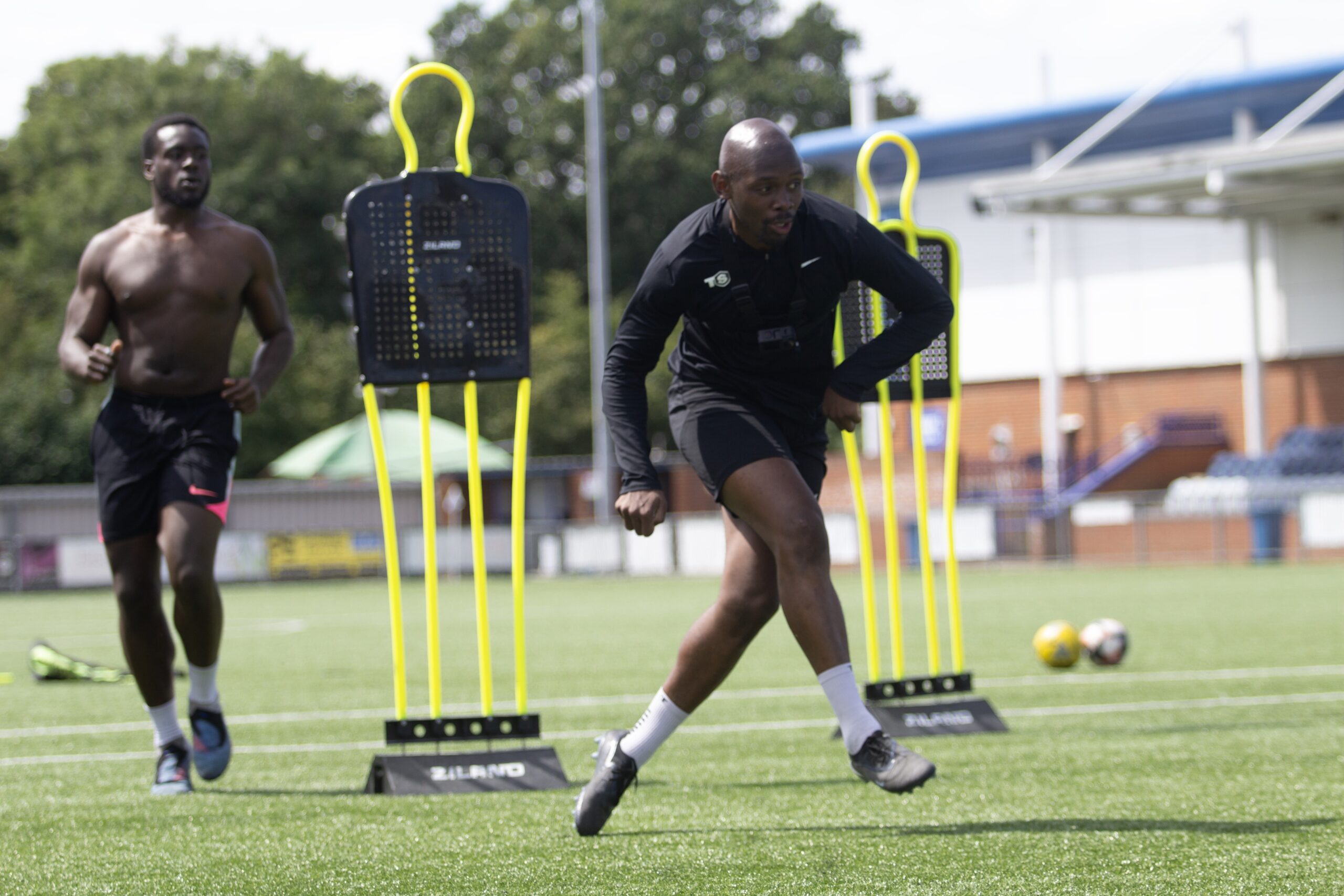
When a striker misses, attention usually goes straight to the final contact.
Did they lean back? Did they strike the centre of the ball? Should they have used the other foot?
Those questions can be useful, but many chances are damaged before the shot even happens. The striker may arrive in the wrong space, receive without enough information or choose a finish that does not suit the position of the goalkeeper.
More shooting practice will not automatically solve those problems.
Three habits have a major influence on whether a chance becomes a goal: purposeful movement, early scanning and choosing the right type of finish. Improve those details and the final action often becomes simpler.
Mistake one: moving without creating an advantage
Movement is not automatically effective just because a striker is running.
A forward can work hard while making themselves easy to defend. They may stay directly in a centre-back’s eyeline, begin the run too early or enter the penalty area without considering where the service is likely to arrive.
Good movement has a purpose. It should create space, open a passing lane, move a defender or prepare the striker to attack the next action.
Why predictable movement causes problems
A defender is comfortable when the striker stays visible and moves at one speed. The defender can follow the run without changing their body position or making a difficult decision.
Straight runs can also reduce the passer’s options. If the forward runs directly towards the ball, they may close the space they need to receive. If they sprint behind too early, they can become offside or force the passer to play before they are ready.
Inside the box, running towards the goal line can take the striker underneath a cut-back. Moving to the same post as a teammate can also crowd the best finishing space.
How to improve striker movement
Begin by connecting the run to the player in possession. Watch their body shape, touch and available passing angle.
Then consider what the defender can see. Moving onto the blind side makes the striker harder to track. A double movement—first one way, then another—can shift the defender’s balance and create separation.
Changes of speed are equally important. A striker can begin slowly, wait for the defender to relax and then accelerate as the pass or cross is prepared.
In the penalty area, read the likely delivery:
- Attack the near post when the ball can be driven across the front of goal.
- Hold or move towards the far post when the service is likely to travel across the goalkeeper.
- Pull away from the goal line when a cut-back is developing.
- Continue moving after the first action in case the ball rebounds or is only partially cleared.
The objective is not more movement. It is better-timed movement into a useful space.
Mistake two: scanning after the ball arrives
Some strikers wait until they receive possession before looking for the defender, goalkeeper or next pass.
By then, the opportunity may already be disappearing.
A player who has not scanned often takes an extra touch simply to understand the situation. That delay gives defenders time to close down and allows the goalkeeper to set.
What a striker should scan for
Scanning means gathering useful information before the action. It is not looking around without a clear purpose.
Before receiving, the striker should try to identify:
- The location and distance of the nearest defender.
- Whether pressure is arriving from the left or right.
- The position of the goalkeeper.
- The space available for the first touch.
- Supporting teammates and possible combinations.
- Whether a first-time finish is available.
This information shapes the next action. A striker who knows the defender is tight may protect the ball or set it one touch. If the defender has dropped away, the forward can receive on the half-turn and attack the goal.
When should a striker scan?
The striker should scan more than once because the picture changes as the ball moves.
A practical sequence is:
- Scan before moving to understand the starting picture.
- Check again as the passer prepares to play the ball.
- Take one final look immediately before receiving, if time allows.
The final glance is especially valuable because it provides the most current information. The player must then return their eyes to the ball to control or finish cleanly.
Scanning should become part of every practice. A coach can encourage it by changing the position of defenders, using coloured or numbered targets, or asking the player to call information before receiving.
Mistake three: using power when the situation needs precision
Strikers often want to strike every chance as hard as possible.
Power can be useful, particularly when shooting through a crowded area or trying to beat a goalkeeper before they react. But unnecessary power can reduce control, increase tension and make the finish easier to read.
The best finish is the one that solves the specific problem presented by the goalkeeper and defenders.
Read the goalkeeper before choosing the finish
The striker should notice the goalkeeper’s distance, balance and movement.
If the goalkeeper is rushing out quickly, an early finish or controlled touch around them may be more effective than a powerful shot. If the goalkeeper has left space at the near post, a quick finish there can catch them before they reset. When they are set centrally, guiding the ball accurately towards a corner may be the better choice.
For a close-range cross, the striker may only need to redirect the existing pace of the ball. Trying to smash it can make the contact less reliable.
Match the technique to the chance
Different situations require different finishing tools:
- Side-foot finish: Useful for control and accuracy when the striker has a clear target.
- Laces finish: Appropriate when speed and a clean strike are required.
- First-time redirection: Effective for crosses and cut-backs that already carry pace.
- Low finish across goal: Can force the goalkeeper to cover a large distance and may create a rebound.
- Near-post finish: Useful when the goalkeeper anticipates a shot across goal.
- Lifted finish: An option when the goalkeeper commits low and early, but only when the striker has enough control.
Young players should build a range of techniques rather than depend on one preferred finish.
How the three mistakes connect
Movement, scanning and finishing are not separate parts of the game.
Better movement creates extra time. Early scanning helps the striker use that time. A clear picture allows the player to choose the correct finish.
The opposite is also true. Poor movement creates a rushed receiving position. Late scanning produces an extra touch. The striker then shoots under pressure and relies on power because the opportunity is closing.
This is why shooting alone is not always the answer to missed chances. The entire sequence must be examined.
A training practice to improve all three habits
Set up a goal with a goalkeeper, one striker, one recovering defender and two servers: one in a wide position and one centrally.
The striker starts away from the defender and must scan both servers. On the coach’s signal, one server begins the attack. The striker chooses a movement based on the angle of the ball and the defender’s position.
The server can vary the delivery between:
- A pass to feet.
- A ball into the channel.
- A low cross towards the near or far post.
- A cut-back.
- A shot that may produce a rebound.
The recovering defender creates realistic pressure without making every repetition identical. The striker must move with purpose, scan before receiving and select an appropriate finish.
After each attempt, review the sequence rather than discussing only whether the ball went in:
- Did the movement create an advantage?
- What information did the striker collect?
- Did the chosen finish suit the goalkeeper’s position?
This feedback helps the player understand the cause of the outcome.
Use misses as information
A missed chance is not automatically a technical failure.
The striker may have made an intelligent run, scanned correctly and selected the right finish but executed it slightly wide. That requires a different response from a chance where the player never looked up and shot directly at a set goalkeeper.
Players should learn to review the process honestly. Identify the first detail that could have been improved and take that lesson into the next repetition.
This prevents frustration from turning into rushed decisions. It also gives the striker something specific to train.
Frequently asked questions
Why do I miss chances even though I practise shooting?
The problem may begin before the strike. Your movement, scanning, first touch or choice of finish can make the shot more difficult. Train the complete sequence rather than the contact alone.
How can a striker improve scanning?
Build scanning into receiving and finishing exercises. Check for defenders, the goalkeeper and available space before the pass, then look back at the ball in time to control or finish.
Should strikers always shoot with power?
No. The finish should suit the situation. Accuracy, timing and disguise are often more valuable than maximum power, especially from close range.
What makes striker movement effective?
Effective movement is timed with the player in possession and creates an advantage. It may open a passing lane, move a defender or help the striker attack the correct scoring space.
How should a striker respond after missing?
Review the process calmly. Identify whether the movement, information, decision or execution needs improvement, then prepare for the next opportunity.
Build better habits before the shot
Half a Yard provides specialist striker and finishing development focused on the details that create and convert chances. Players work on movement, scanning, decisions and finishing in realistic situations.
Explore striker coaching or book a session.
Developed from a Half a Yard coaching carousel. View the original Instagram post.