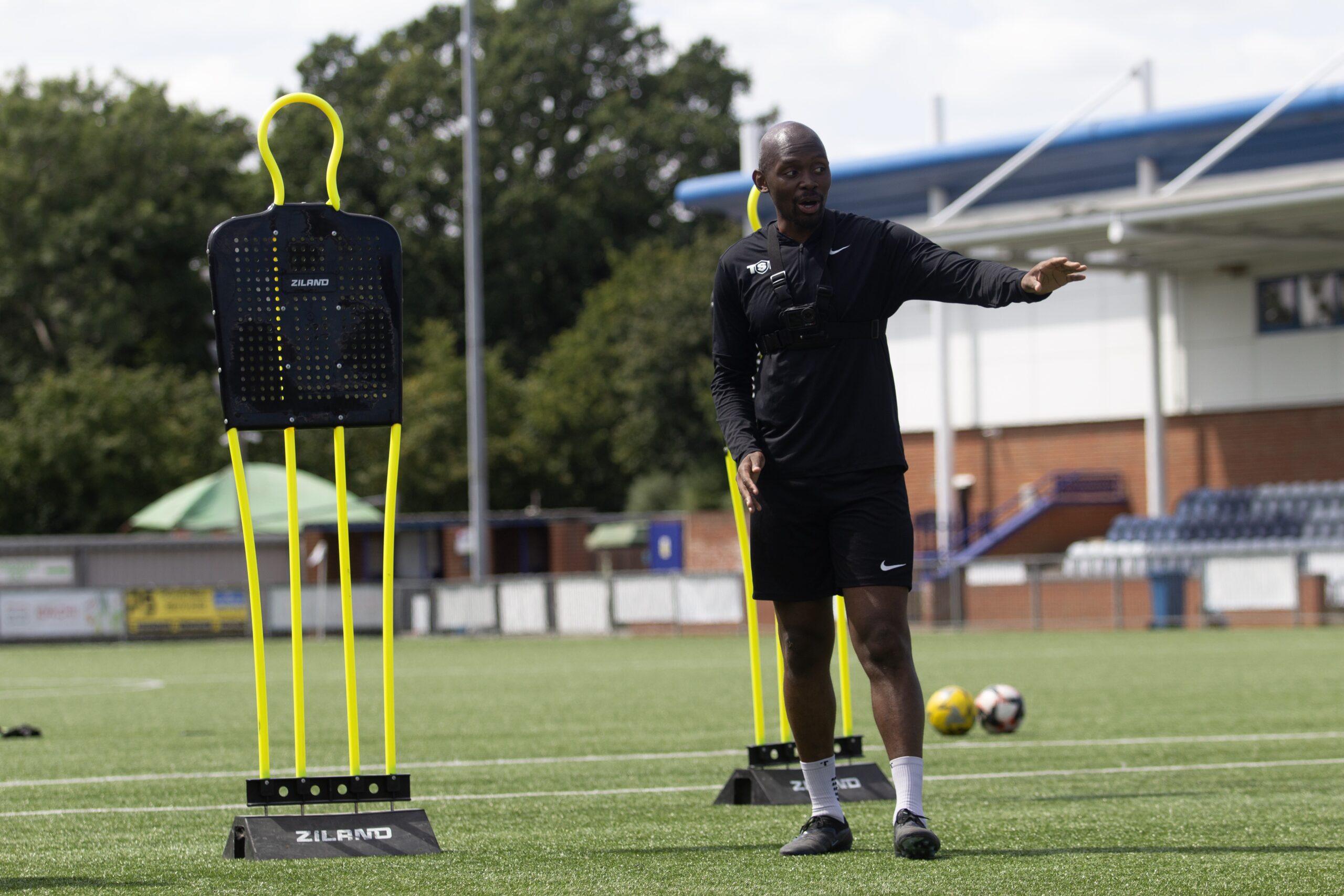
A striker does not always need several metres of open grass to make a difference.
Sometimes half a yard is enough.
Half a yard can create the passing lane needed to receive. It can provide the room to turn away from a defender or the fraction of a second required to release a shot before pressure arrives.
That space is rarely handed to the striker. It is created through intelligent movement, body position, a purposeful first touch and the ability to recognise what the defender is trying to do.
For young attacking players, learning how to create small advantages is just as important as learning how to finish. Better movement and preparation make every technical action easier.
Why small spaces matter for strikers
Defenders want to remove a striker’s time. They stay close, block forward passes and try to force the attacker away from goal.
The striker’s task is not always to escape completely. In crowded areas, that may be unrealistic. The aim is often to create just enough distance to perform the next action cleanly.
That small advantage can allow the forward to:
- Receive without the defender touching the ball.
- Turn onto their stronger side.
- Set a teammate with an accurate pass.
- Shift the ball into a shooting lane.
- Protect possession while support arrives.
- Finish before the goalkeeper can set.
The faster the level of football, the more important these small margins become.
Start where the defender cannot see everything
A defender is more comfortable when the striker and the ball are visible at the same time.
The forward can make the situation harder by moving towards the defender’s blind side. This is the area outside the defender’s immediate field of vision, often just behind one shoulder.
From this position, the striker can see both the ball and the defender while forcing the defender to turn their head. The moment the defender looks towards the ball can become the signal to move.
This does not require a long sprint. One or two quiet adjustment steps can create a better receiving angle or prepare the striker to accelerate into space.
A useful question for young players is: Can you see the defender without making it easy for the defender to see you?
Use double movements to create separation
A straight run at one speed is predictable. A double movement gives the defender two problems to solve.
The striker might first step towards the ball before spinning behind. They could move towards the near post before pulling away to the far post. With their back to goal, they might lean into the defender and then release into the space beside them.
The first movement influences the defender. The second movement attacks the space that response creates.
Timing is essential. If the second movement begins too early, the defender can recover. If it begins too late, the passing opportunity disappears. The striker must connect their movement to the player on the ball.
Look for the moment when the passer lifts their head, takes a preparation touch or changes their body shape. Those clues often signal that the ball can be played.
Change speed, not only direction
Separation is produced by changes of pace as well as changes of direction.
A striker who moves at maximum speed all the time becomes easier to read. There is no extra gear available when the important moment arrives.
Instead, the forward can begin slowly, tempt the defender to relax and then accelerate sharply. The sudden change forces the defender to adjust their feet and body position. That reaction creates the small gap the attacker needs.
Young players should practise moving through different speeds: walking, jogging, holding a position and then exploding. The important action is often the transition between speeds rather than the top speed itself.
Prepare the body before receiving
Space can disappear before the first touch if the striker receives in a poor body position.
When possible, the forward should receive side-on rather than completely square to the ball. A side-on position makes it easier to see more of the pitch and play forwards with fewer touches.
Before the pass arrives, the striker should scan for:
- The distance and angle of the nearest defender.
- Space available on either side.
- The goalkeeper’s position.
- Supporting teammates.
- The next action they want to perform.
This information helps the striker choose the correct receiving foot and contact. The decision begins before the ball reaches them.
Make the first touch purposeful
A good first touch does not simply control the ball. It improves the next action.
If the defender is tight, the striker may use the first touch to protect the ball or take it across the defender’s path. If pressure is arriving from one side, the touch can travel into the free space on the other. When the defender stands off, the touch can move forwards and prepare an immediate shot.
The ideal touch distance changes with the situation. A small touch keeps the ball safe in a crowded area. A larger touch can exploit space and build speed when the striker has escaped pressure.
The player should avoid taking a neutral touch that leaves the ball directly underneath the body. That position often requires another adjustment before a pass or shot can be made, giving the defender time to close the gap.
Use the body to disguise the next action
Strikers can create space by making the defender expect one action before performing another.
The eyes, shoulders, hips and first step can all sell a false intention. A forward might shape as if they will set the ball back to a midfielder, then roll the defender and turn. They might open their body as if shooting across goal before finishing at the near post.
Deception does not need to be complicated. A convincing shift of body weight can be enough to move a defender or goalkeeper by half a step.
The most effective disguise is connected to a realistic action. The defender must believe the striker could genuinely pass, turn or shoot in the direction being shown.
Protect the space you create
Creating separation is only useful if the striker can keep the advantage.
Once the forward moves in front of a defender, their body can act as a barrier between the opponent and the ball. A strong base, bent knees and balanced upper body help the striker absorb contact without losing control.
The arms can be used naturally for balance and awareness, but not to push or hold. The objective is to feel where the defender is and keep the ball on the safe side.
This is particularly important when receiving with the back to goal. Good protection gives the striker time to link play, turn or win a foul when the defender becomes impatient.
Train the action under realistic pressure
Repetition matters, but the repetitions should contain decisions.
A simple practice can use a striker, defender, server and goal. The striker begins between the defender and the server, then attempts to create enough space to receive and finish. The server varies whether the pass goes to feet, into the channel or behind the defender.
The striker must scan and decide whether to:
- Drop towards the ball.
- Make a double movement and run behind.
- Receive side-on and turn.
- Protect the ball and link with the server.
- Shift the ball quickly to create a shot.
Progress the practice by giving the striker a limited number of touches or adding a recovering defender. Award points for the quality of the movement and decision, not only for scoring.
Unopposed technique still has a place, especially for younger players learning a new action. Live pressure should then be introduced so they learn when and why to use it.
Repetition creates confidence
Confidence is not only a feeling. It is built through evidence.
When players repeatedly recognise pressure, create separation and perform the next action successfully, they begin to trust their decisions. The movement becomes quicker and more natural because less time is spent consciously organising every step.
This does not mean repeating the exact same pattern hundreds of times. Football is unpredictable. Valuable repetition presents the player with similar problems but allows the position of the defender, type of pass and available space to change.
The consistent element is the principle: read the situation, create an advantage and use it with purpose.
Frequently asked questions
How can a striker create space from a defender?
A striker can move onto the defender’s blind side, use a double movement, change speed or make a purposeful first touch away from pressure. The correct action depends on the position of the ball and defender.
What is a double movement in football?
A double movement uses an initial run to influence the defender before changing direction. For example, a striker may move towards the ball and then spin into the space behind.
Why is body shape important when receiving?
An open or side-on body position helps the player see more of the pitch and makes it easier to play forwards. A closed body position can limit the next action and allow pressure to arrive unnoticed.
Should a first touch always be close?
No. A close touch is useful in crowded areas, while a larger touch can exploit open space. The first touch should suit the pressure and prepare the player’s intended next action.
Can young players learn striker movement?
Yes. Age-appropriate practices can teach scanning, timing, changes of speed and purposeful movement. The complexity and pressure should increase gradually as the player develops.
Find your half a yard
Half a Yard provides specialist striker and finishing development designed to help young players become more confident, intelligent and complete attackers.
Explore striker coaching or book a session.
Developed from a Half a Yard coaching carousel. View the original Instagram post.